
iReady Diagnostic Scores 2026 by Grade – Math and Reading
iReady Diagnostic Scores 2026: What’s New, What’s Changing, and How to Interpret your Child´s Results.
i-Ready Diagnostic has been a core assessment tool in U.S. K–12 education for more than 10 years. By 2026, millions of students, parents, and educators rely on i-Ready results. The tool helps to understand student performance in math and reading and their growth over time.
As schools prepare for 2026, i-Ready Diagnostic is entering a period of meaningful change. These updates build on the 2024–2025 framework while responding directly to educator feedback around testing time, clarity of reports, and instructional usefulness. At the same time, score interpretation, grade-level expectations, and percentile benchmarks remain central to how i-Ready results are used in classrooms and homes.
Quick Links.
See the iReady Diagnostic Scores (with Percentiles) by Grade Chart for Math for 2024-2025
See the iReady Diagnostic Scores (with Percentiles) by Grade Chart for Reading for 2024-2025
See the iReady Diagnostic Scores Percentiles by Grade Chart for Math for 2024-2025
See the iReady Diagnostic Scores Percentiles by Grade Chart for Reading for 2024-2025
Major News: i-Ready Diagnostic Becomes i-Ready Inform
In November 2025, Curriculum Associates announced a major evolution of its flagship assessment. Beginning with the 2026–2027 school year, i-Ready Diagnostic will officially be renamed i-Ready Inform.
The new name reflects a shift in emphasis. Rather than focusing on diagnosis alone, the assessment is positioned as a tool designed to inform instruction, support students, and guide families with clearer, more actionable insights.
According to Curriculum Associates CEO Kelly Sia, the change highlights the purpose educators have relied on for years: understanding what students know and determining the next instructional steps. The assessment itself remains adaptive and standards-aligned, but the branding and reporting philosophy emphasize clarity, purpose, and usability.
The rollout of the new name begins during the 2025–2026 school year and will be fully implemented by the start of the 2026–2027 school year. During this transition, schools may still see references to both “i-Ready Diagnostic” and “i-Ready Inform,” but the scoring structure and growth measures remain consistent.
Shorter i-Ready Assessment in 2026–2027
Another important update tied to the i-Ready Inform announcement is the availability of a shorter assessment option starting in the 2026–2027 school year.
Educators have long requested a balance between rich data and reduced testing time. In response, Curriculum Associates developed a streamlined version of the assessment that uses fewer questions while preserving the core qualities that schools depend on:
- Valid and reliable measurement
- Adaptive question delivery
- Clear instructional insights
- Actionable reports for teachers and families
This shorter version does not change how scores are reported or interpreted. Scale scores, placement levels, and percentiles remain comparable, allowing schools to track growth across years without losing continuity.
What’s New From 2024–2025 to 2026
While the fundamentals of i-Ready Diagnostic scoring remain stable, several refinements distinguish 2026 from earlier years.
First, reporting clarity continues to improve. Reports are designed to be more readable for parents and students, with clearer language around grade-level expectations, on-grade placement, and areas for growth.
Second, efficiency is a central theme. The introduction of shorter testing options reflects a broader effort to reduce assessment fatigue while maintaining instructional value.
Third, alignment across years has been preserved. Students tested in 2024–2025, 2025–2026, and 2026–2027 can still be compared using consistent scale scores and growth measures. This continuity is essential for long-term progress monitoring.
Finally, professional guidance around score interpretation has expanded. Schools increasingly pair i-Ready results with percentile explanations, instructional groupings, and growth targets rather than treating scores as isolated numbers.
i-Ready Diagnostic Math Scores in 2026
i-Ready Diagnostic math scores in 2026 continue to measure student understanding across key domains, including number sense, algebraic thinking, geometry, and data analysis.
Each student receives a math scale score that reflects overall performance. This score is then mapped to:
- Grade-level placement
- Below grade, on grade, or above grade indicators
- Instructional group recommendations
Math scores are adaptive, meaning students see questions that adjust in difficulty based on their responses. This allows i-Ready to identify not only whether a student is behind or ahead, but specifically which skills need support.
In 2026, math score interpretation remains focused on instructional planning. Teachers use results to group students, assign targeted lessons, and monitor growth across fall, winter, and spring testing windows.
i-Ready Diagnostic Reading Scores in 2026
Reading scores in i-Ready Diagnostic measure a combination of foundational skills and comprehension abilities. Depending on grade level, this includes phonological awareness, phonics, vocabulary, and text comprehension.
As with math, reading results are reported using scale scores, placement levels, and growth indicators. These scores help educators understand whether a student is reading below, on, or above grade level and which reading components require attention.
In 2026, reading reports continue to emphasize actionable insights. Rather than focusing solely on a single score, reports highlight strengths, gaps, and recommended instructional pathways.
Understanding i-Ready Percentiles in 2026
Percentiles are a critical part of interpreting i-Ready Diagnostic scores. A percentile rank compares a student’s performance to a national sample of students in the same grade.
For example, a student at the 60th percentile performed as well as or better than 60 percent of peers nationwide. Percentiles do not represent a percentage correct and should not be interpreted as grades.
In 2026, percentiles remain essential for:
- Understanding relative performance
- Identifying students who may need intervention or enrichment
- Communicating results clearly to families
Many parents find percentiles easier to understand than scale scores, especially when paired with grade-level placement explanations.
i-Ready Diagnostic Scores Charts for 2024–2025 in Math
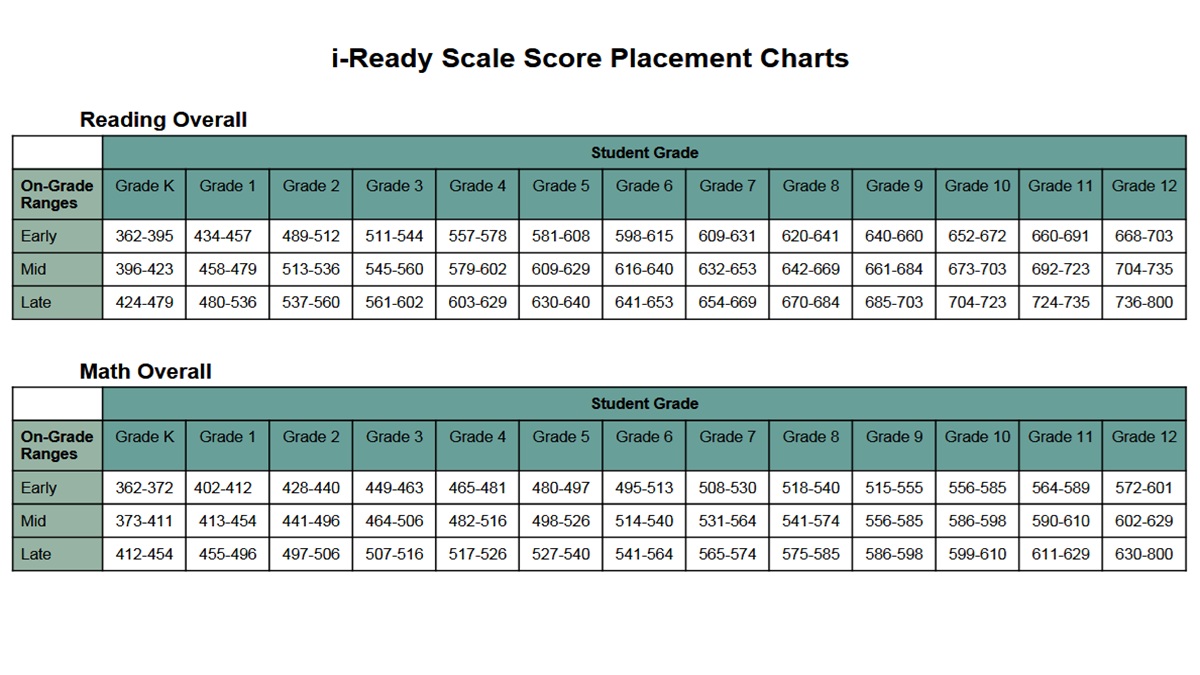
Although 2026 introduces new naming and testing options, 2024–2025 score charts remain highly relevant. These charts provide detailed grade-level scale score ranges, placement thresholds, and percentile benchmarks for math.
On SchoolTest.org, you can find comprehensive i-Ready Diagnostic math score charts for the 2024–2025 school year. These charts break down expected score ranges by grade and testing window, making them useful for parents and educators comparing results across years.
See the iReady Diagnostic Scores by Grade Chart for Math for 2024-2025
See the iReady Diagnostic Scores by Grade Percentiles Chart for Math for 2024-2025
i-Ready Diagnostic Scores Charts for 2024–2025 in Reading
Reading score charts from 2024–2025 are equally important for understanding 2026 results. These charts outline grade-level expectations, scale score ranges, and percentile cutoffs for reading.
SchoolTest.org provides detailed reading score charts that help explain what different score ranges mean and how students typically progress across the school year. These resources are often used alongside current-year results to provide context and reassurance.
See the iReady Diagnostic Scores by Grade Chart for Reading for 2024-2025
See the iReady Diagnostic Scores by Grade Percentiles Chart for Reading for 2024-2025
How to Interpret i-Ready Scores Correctly
Interpreting i-Ready scores requires looking beyond a single number. Effective interpretation includes:
- Reviewing placement levels rather than focusing only on percentiles
- Comparing fall, winter, and spring results to track growth
- Understanding that short-term fluctuations are normal
- Using results to guide instruction, not label students
Parents are encouraged to discuss results with teachers and use percentile and placement explanations together. Guides on SchoolTest.org walk through this process step by step, helping families understand what scores really mean.
Frequently Asked Questions About i-Ready Diagnostic Scores in 2026
Are i-Ready Diagnostic scores changing in 2026?
The way scores are calculated and reported remains consistent in 2026. While the assessment is transitioning to the name i-Ready Inform and offering a shorter testing option, scale scores, placements, and percentiles are still comparable to previous years.
What does the name change to i-Ready Inform mean for parents?
The name change reflects a focus on clarity and instructional guidance. Parents will still see familiar reports and score types, but with clearer explanations and more emphasis on how results guide learning.
Will 2024–2025 i-Ready score charts still apply in 2026?
Yes. Score charts from 2024–2025 remain useful for understanding expectations and benchmarks. They provide valuable context when reviewing 2026 results, especially when comparing growth across years.
Are i-Ready math and reading scores equally important?
Both subjects are important, but they measure different skills. Math scores highlight numerical and problem-solving abilities, while reading scores reflect comprehension and foundational literacy skills. Together, they give a complete picture of academic readiness.
How often should students take i-Ready in 2026?
Most schools continue to administer i-Ready in fall, winter, and spring. Some schools may adjust schedules slightly with the shorter assessment option, but multiple testing windows are still common for tracking growth.
Where can parents find reliable explanations of i-Ready scores?
SchoolTest.org offers detailed guides, charts, and explanations for i-Ready Diagnostic scores, percentiles, and grade-level expectations. These resources are designed to help parents and educators interpret results confidently.
What does an i-Ready Diagnostic score mean?
An i-Ready Diagnostic score is a scale score that estimates a student’s current achievement level in a subject area like reading or math. Because the assessment is adaptive, the score reflects the level of question difficulty a student can consistently handle. Schools use it to guide instruction, identify needs, and track growth across testing windows.
How do i-Ready Diagnostic scores work?
i-Ready uses an adaptive test that adjusts the next questions based on a student’s answers. The system produces a scale score and a placement level (below, on, or above grade level). Those results are then linked to skill reports so teachers can choose what to teach next.
What is a “good” i-Ready Diagnostic score?
A good i-Ready score is usually one that falls within or above the on-grade-level range for your child’s grade and season (fall, winter, spring). Because the expected score ranges change by grade and time of year, a single number is not “good” for everyone. The best way to judge a score is to compare it to your school’s placement chart and your child’s past results.
Is i-Ready Diagnostic important?
i-Ready is important because it helps schools understand what students are ready to learn next and where they might need extra support. It is commonly used for instructional planning and progress monitoring. It is not the only measure of learning, so it should be viewed alongside classwork, teacher observations, and other assessments.
What is i-Ready used for?
Schools use i-Ready to screen skills, set growth goals, group students for instruction, and assign targeted lessons. Teachers often use the reports to choose small-group skills and monitor improvement from fall to spring. Families may use it to understand strengths, challenges, and what to practice at home.
Why did my child get a lower score than last time?
A score can dip if the test covered harder skills, if your child rushed, or if they were tired or distracted. Because the test adapts quickly, a few early mistakes can change the difficulty path and affect the final score. The more meaningful view is the overall trend across multiple testing windows.
What is the difference between scale score, percentile, and placement?
The scale score is the main number i-Ready uses to represent performance on a continuous scale. A percentile compares your child to a national group of students in the same grade. Placement tells whether performance is below, on, or above grade level based on the school’s benchmarks for that season.
How do I interpret the i-Ready placement level?
Placement levels show where your child is relative to grade-level expectations at the time of testing. “On grade level” typically means the score falls within the expected range for that grade and season. “Above” and “below” indicate the student is performing beyond or behind those expectations, often with additional detail on how far.
How do I interpret i-Ready percentiles?
Percentiles show how your child compares to other students in the same grade nationally. A 60th percentile means your child scored as well as or better than 60 out of 100 peers. Percentiles are not the percent of questions correct, and they are best used with placement and growth.
What does “overall reading level” mean in i-Ready Reading?
Overall reading level is a summary of how a student performs across the skills i-Ready measures for reading. It often aligns to whether the student is reading below, at, or above grade level in the i-Ready framework. The detailed domains explain what is driving that overall result.
What are i-Ready Reading Diagnostic domain scores?
Domain scores break reading into specific skill areas so teachers can see what needs work. Depending on grade, domains can include phonics, vocabulary, and comprehension-related skills. These details matter because two students with similar overall scores may need help in different areas.
What are i-Ready Math Diagnostic domain scores?
Math domain scores show which areas are strongest and weakest, such as number and operations or algebraic thinking. This helps teachers target instruction rather than reteaching everything. Domain information often explains why a student is below or above grade level overall.
What is “typical growth” in i-Ready?
Typical growth is the amount of progress many students make over a certain period, often from fall to winter or fall to spring. It helps teachers set realistic expectations for growth, especially when a student starts below grade level. Some schools also track stretch growth, which is a more ambitious target.
What is “stretch growth” and why does it matter?
Stretch growth is an above-typical growth goal that helps students catch up or accelerate beyond grade level. It matters because a student who is behind may need more than typical growth to reach grade expectations. Teachers may use stretch growth to plan intervention and monitor progress closely.
How accurate are i-Ready Diagnostic scores?
i-Ready is designed to provide a consistent estimate of skill level, but no assessment is perfect. Scores can be influenced by motivation, test-taking behavior, and the testing environment. The most reliable interpretation comes from patterns over time and the skill-level reports, not a single sitting.
Can a student “fail” i-Ready?
i-Ready Diagnostic is not a pass/fail test, so students do not fail it in the traditional sense. The score is meant to identify current skill level so instruction can match the student’s needs. If results are low, it usually means the school should provide targeted support, not punishment.
What happens if my child scores very low on i-Ready?
A very low score typically leads to added instructional supports, such as small-group lessons, skill practice, or intervention time. Teachers may focus on foundational skills first to build momentum and confidence. Families can help by asking which specific skills to practice rather than worrying about the score alone.
What is the lowest possible score on i-Ready?
i-Ready uses a scale score system, and the lowest score depends on the subject, grade band, and the scale design. Most families do not need to focus on the absolute minimum; what matters is where your child lands relative to grade expectations. If you see a very low score, ask the teacher which foundational skills the report is highlighting.
Can you get 100% on i-Ready?
i-Ready Diagnostic does not work like a traditional test where you aim for 100% correct. Because it is adaptive, it will keep giving harder questions until it finds the edge of a student’s ability. Even strong students will miss questions, and that is normal in an adaptive assessment.
What does a score like 590 on i-Ready mean?
A number like 590 is a scale score, but its meaning depends on the student’s grade and the testing season. The same score could be on-grade for one grade level and below-grade for another. The correct interpretation comes from the grade-and-season placement chart your school uses.
What does a score like 666 on i-Ready mean?
A score like 666 is simply a scale score and does not automatically mean a specific grade level by itself. i-Ready interpretations depend on grade and testing window because expectations rise across the year. Check the placement band and the domain breakdown to understand what the number represents.
What grade level is 540 in i-Ready?
A score like 540 cannot be tied to one grade level without knowing the subject, the grade tested, and the season. i-Ready uses different cut points for different grades and testing windows. The best approach is to read the report’s placement statement and compare it to your school’s published chart.
What is 7th grade level in i-Ready?
“7th grade level” in i-Ready usually refers to a placement range for seventh grade in a specific season. That range changes from fall to spring because students are expected to grow. Schools typically use a chart to define what counts as on-grade for seventh grade each term.
How do I see my child’s i-Ready scores?
Many schools share i-Ready reports through a parent portal, email, printed reports, or a learning platform used by the district. If you are unsure where to find them, contact your child’s teacher or school office and ask how reports are delivered. You can also request both the overall score page and the domain detail pages for clearer next steps.
How often do students take i-Ready Diagnostic?
Many schools give i-Ready three times per year: fall, winter, and spring. Some districts use additional windows for progress monitoring or intervention groups. The schedule is set by your district, so the teacher or school site usually has the most accurate timeline.
How long does the i-Ready Diagnostic take?
Testing time varies by grade, subject, and student pace, and many schools split it into multiple sessions. The adaptive design means students may see different numbers of questions. If your child struggles with stamina, shorter sessions on different days can help maintain performance.
Why are Curriculum Associates changing the name from i-Ready Diagnostic to i-Ready Inform?
The name change is meant to better reflect the assessment’s purpose: informing instruction and helping teachers, families, and students make learning decisions. “Inform” highlights actionable next steps rather than focusing only on diagnosis. The change also comes with a push toward clearer reporting and more efficient testing options in the 2026–2027 school year.
Is i-Ready Inform a new test or the same test with a new name?
i-Ready Inform is the new name for the assessment previously known as i-Ready Diagnostic. The core approach remains an adaptive assessment that produces reliable scores and instructional insights. Schools may see gradual branding changes during the transition period.
Will i-Ready be shorter in 2026–2027?
Curriculum Associates has announced a shorter assessment option starting in the 2026–2027 school year. The intent is to reduce testing time while keeping the data useful and dependable. Your district may choose whether and how to use the shorter version.
Why does my child’s i-Ready score not match their classroom grades?
Classroom grades reflect assignments, participation, projects, and teacher expectations, while i-Ready is a single adaptive snapshot. A student can work hard in class yet still show gaps in certain skills on i-Ready. The results help explain which skills need reinforcement.
How can parents help improve i-Ready scores?
Parents can help most by focusing on the specific skills listed in the report rather than drilling random topics. Short, consistent practice sessions and reading routines often lead to steady growth. Supporting good test habits like sleep and focus also helps.
How should students prepare for i-Ready Diagnostic?
Students do not need heavy test prep, but they should be well rested and calm. Reading questions carefully and taking time on each problem matters more than speed. Understanding that missing some questions is normal can reduce anxiety.
Can students retake i-Ready Diagnostic?
Retakes are a district decision and are not always offered. If there was a serious issue during testing, some schools may allow a reset. The best step is to ask the teacher about local policy.
What accommodations are available for students with IEPs or 504 plans?
Many districts offer accommodations such as extended time or text-to-speech when appropriate. These supports aim to remove barriers without changing what the test measures. Families should confirm accommodations before testing begins.
What does “below grade level” really mean on i-Ready?
Below grade level means the score is under the expected range for that grade and season. It does not define a child’s ability or potential. The skill breakdown shows exactly what needs support.
What does “above grade level” mean on i-Ready?
Above grade level indicates performance beyond the expected range for that grade and season. It often signals readiness for enrichment or more advanced work. Teachers may use this to keep students challenged.
How can I compare fall, winter, and spring i-Ready scores?
Look at changes in scale score and placement across the year. Growth is expected from fall to spring, even if placement stays the same. Domain progress helps explain where growth occurred.
Do i-Ready scores affect report cards or promotion?
In most districts, i-Ready is used for instructional planning rather than grading. Some schools include it as one data point for placement decisions. Ask your school how i-Ready is used locally.
How much is i-Ready for parents?
Parents usually do not buy i-Ready directly because schools license it at the district level. Access to reports depends on school policy. Families should ask what viewing options are available.
i-Ready Diagnostic scores in 2026 build on a familiar foundation while introducing meaningful improvements. The transition to i-Ready Inform, the availability of shorter assessments, and clearer reporting all point toward a more efficient and instructional-focused future.
By understanding how math and reading scores work, how percentiles are interpreted, and where to find accurate charts and guides, families and educators can use i-Ready results as intended: to inform learning, support growth, and help every student thrive.
Quick Links.
See the iReady Diagnostic Scores (with Percentiles) by Grade Chart for Math for 2024-2025
See the iReady Diagnostic Scores (with Percentiles) by Grade Chart for Reading for 2024-2025
See the iReady Diagnostic Scores Percentiles by Grade Chart for Math for 2024-2025
See the iReady Diagnostic Scores Percentiles by Grade Chart for Reading for 2024-2025